Chandauli, Uttar Pradesh · 20 TPD
A 20 TPD biomass pellet plant in the Chandauli paddy belt.
AGRIDFUEL supplies bio-coal pellets to coal-fired power stations and steel plants. The pellets are made from crop residue that we collect and bale ourselves, on farms in the area around the plant.
- Capacity
- 20 TPDChandauli plant
- Feedstock
- Collected directBought at the farm gate
- Site tenure
- 20 yearsLease, conversion complete
- Power
- SanctionedConnection approved

Our feedstock comes from the farms around the plant.
Most biomass pellet suppliers are limited by feedstock availability rather than by plant capacity. A supplier who cannot collect crop residue at scale cannot sustain a rate contract. We have sited the plant among the farms that produce the residue, and we collect and bale it with our own equipment.


Short collection distances
Because the farms are close to the plant, transport is a smaller share of our feedstock cost and there are fewer intermediaries between the field and the pellet mill.
Collection we run ourselves
We own two balers and treat collection as part of our own operation rather than buying baled residue from traders. That is what allows us to commit to a supply rate across a season.

Government notification
7%
Coal-based plants must co-fire a minimum share of biomass.
Under a government notification, entities using coal are required to meet a minimum share of their consumption from biomass. Pellets are fed through existing coal handling equipment, so no boiler modification or additional capital plant is needed. The requirement is continuous, so it calls for a supply arrangement rather than a single purchase.
Handled by existing equipment
Densified crop residue passes through the conveyors, crushers and feeders already installed at the plant, and is co-fired alongside coal.
Quoted on calorific value
We quote on a rupee per 1,000 kcal basis, so the cost can be compared directly against your landed cost of coal.

From collection to dispatch
Five stages. The first four are carried out by our own team and equipment.
Crop residue
Residue is left in the fields after harvest on the farms around the plant. Most of it would otherwise be cleared by burning.
Baling
We bale the residue using our own two balers, during the window after harvest.
Purchase from the farmer
We buy residue directly from farmers in the area. The farmer is paid for material that would otherwise be burned, and we buy with no trader in between.
Pelletising
Residue is sized, dried and densified into pellets at the Chandauli plant, which has a capacity of 20 tonnes per day.
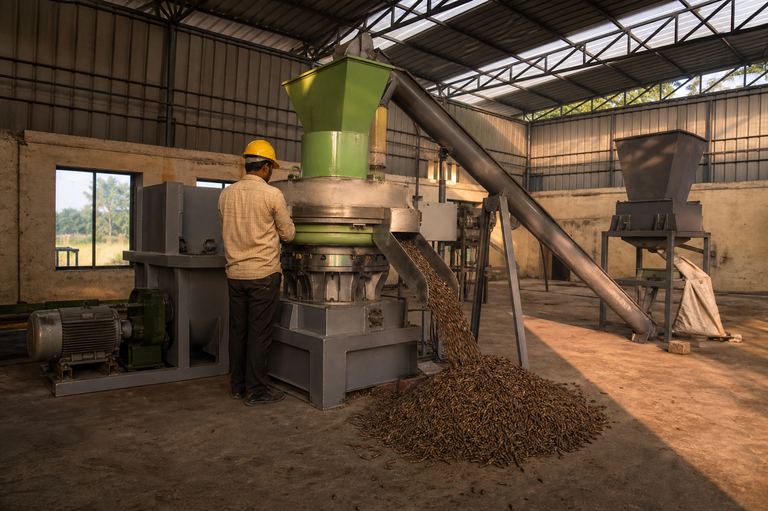
Ring-die pelletising — illustrative, not the Chandauli plant Dispatch
Pellets are weighed at the plant and dispatched by road against the agreed specification.


Specification
Pellets are supplied against an agreed specification, and each consignment is tested.
| Property | Basis | Value |
|---|---|---|
| Gross calorific value | kcal/kg, ar | To confirm |
| Moisture | % by mass | To confirm |
| Ash | % by mass | To confirm |
| Sulphur | % by mass | To confirm |
| Chlorine | % by mass | To confirm |
| Diameter / length | mm | To confirm |
| Bulk density | kg/m³ | To confirm |
| Fines | % by mass | To confirm |
Note. Specification values are being finalised as the plant is commissioned, and will be published together with the test basis for each figure. We would rather give them on enquiry than publish approximate numbers. Please ask for the current specification sheet.
Packaging and dispatch
Supplied loose in bulk or bagged, and dispatched by road from Chandauli. There is a weighbridge at the plant. Bag format is confirmed at the time of order.
Pricing
Quoted on a rupee per 1,000 kcal basis. Tonnage price on enquiry.


The plant
The plant is at Gata Sankhya-123, Auraiya Patti Lal, Tahsil Chandauli, District Chandauli, Uttar Pradesh 232110, in the paddy-growing belt near Varanasi.
The land is held on a twenty-year lease and conversion is complete. The electricity connection has been approved and basic infrastructure is in place. Major plant has been ordered and equipment ordering is complete.
We welcome plant visits. If you are assessing supply security, it is better that you see the site and the surrounding catchment for yourself. Please call to arrange a visit.


The company
AGRIDFUEL is the biomass fuel brand of Ahom Agro Pvt Ltd, a private limited company incorporated in March 2022 and run by its promoter directors.
Anurag Tiwari holds a B.E. and an MBA, and has twenty-eight years of experience in engineering, previously with Siemens. He is responsible for sales, purchase, technical and administrative functions.
Registration details are provided on enquiry.
Where we are
- Entity
- Ahom Agro Pvt Ltd
- Incorporated
- March 2022
- Registered office
- 1784 Venezia, Mahagun Moderne, Sector-78, Noida, UP 201301
- Works
- Gata Sankhya-123, Auraiya Patti Lal, Chandauli, UP 232110
Enquiries
For a specification sheet, sample material, a rate enquiry or a plant visit, please contact us directly.
Also on +91 98107 24238. Plant visits at Chandauli by appointment.